
Search Articles
clear search termsFemale Pattern Baldness or Alopecia Areata?
 Do you know what you’re seeing?
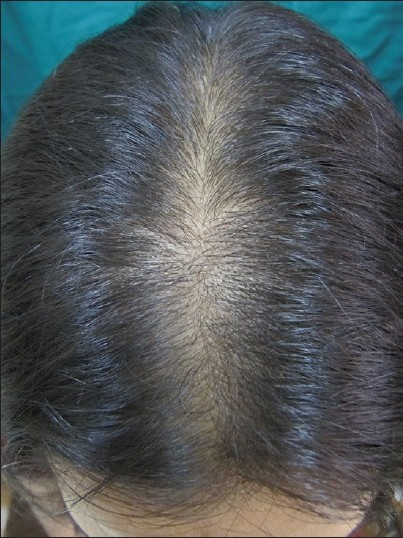 The smaller photo with a marked bald “spot” is an example of alopecia areata. The larger photo with the overall thinning and low-grade balding all along the top of the head is an example of androgen-mediated “male pattern baldness” in a woman. A great example of why we need to dive into the detail of otherwise generic symptoms such as “hair loss” or “hair thinning”.
The detailed write-up below about these dynamics is a sample entry from the SAFM Q&A Treasure Chest , where our students find hundreds of entries to support their client and patient needs…and the ability to post their own. Unlimited access is included as part of the SAFM’s practitioner training in Applied Functional Medicine.
I hope this is helpful to you!

Student Question
Q: Do you have any recommendations for a client with a marked bald spot on the top of her head? I am pretty certain it’s not pattern-baldness due to hormone imbalance. I do have clients to whom that applies; however, this client in particular has a very large bald spot (about silver dollar size) at the top left of her head. Around it is a full mane of Rapunzel hair. She uses eyeshadow to cover the bald spot, but it’s not really visible because of the way she parts her hair. Thanks so much!
SAFM’s Response
A: Generalized alopecia is certainly a possibility, but this tends to result in diffuse hair loss all over or just on the top of the head (as caused by low thyroid function or key nutrient deficiency e.g. B12, iron, zinc).
In this case, it’s likely your client is experiencing Alopecia Areata (AA). (Have her check out some photos .) AA is an autoimmune disorder that attacks the hair follicles and can result in single-spot hair loss or can progress aggressively to total hair loss. Disease progression tends to vary dramatically and to be unpredictable. It may go away on its own, or it may get substantially worse. It may surge and subside during an individual’s lifetime as well (as with all AI dis-ease) allowing regrowth and then repeat loss if the root cause of the disease is not addressed. Regardless, hair regrowth is generally quite slow, so even with effective support, it’s important to set your client’s expectations properly that regrowth can take 6 months or more.
AA follows the dynamics of other autoimmune disorders (there are many other posts about it in the Q&A database), keeping in mind that AA is really a dysfunction of the immune system, where the hair follicles are just an ‘innocent bystander’. You may learn more about AA’s autoimmune dynamics here. This can occur coincident with other autoimmune disease manifestations as well (e.g. Hashimoto’s thyroiditis, vitiligo). In particular, consider the role of molecular mimicry with other infectious dynamics e.g. H. pylori, which has been well documented in alopecia areata (this and this will interest you, as may this).
Many other autoimmune posts on our site already include fundamental autoimmune dynamics and also a number of therapeutic suggestions to reduce inflammation. Consider encouraging your client about all of the following:
- Check Vitamin D and ensure at least 50 ng/ml.
- Ensure both RBC Zinc and Vitamin A are in the upper third of the reference range. Zinc therapy has been shown to be quite effective for those with AA whose zinc levels are suboptimal.
- Eliminate gluten fully. 100%. Because they are so often cross-reactive with gluten, consider eliminating all dairy foods and all grains (regardless of GF or not) for at least 3 months. Remember that autoimmune disorders generally have in common the presence of enhanced intestinal permeability, and gluten can exacerbate this dynamic and prevent healing in sensitive individuals.
- Ideally, check for other food sensitivities with IgG antibody testing (Note: with ongoing AI activation, gluten should likely still be eliminated regardless of what food sensitivity test results reveal).
- Support with a probiotic that includes Saccharomyces boulardii, unless food sensitivity or allergy test in the past has indicated moderate or severe sensitivity to yeast. This particular probiotic species is often effective in priming greater intestinal mucosal immunity, which is especially key for countering opportunistic bacterial overgrowth.
- Salivary or urinary adrenal test for cortisol levels. Levels are sometimes low in those with long-time, chronic autoimmune activation. If so, this dynamic can be supported with either boosting adaptogens (e.g. licorice, eleuthero) and/or adrenal glandular supplements (if markedly low) in order to help stabilize the immune system and reduce inflammation by re-establishing adequate cortisol. Of course, that you still have to find and address the root causes of the autoimmune activation in order to allow the HPA axis to shift and re-establish optimal cortisol.
- Stress reduction and sufficient deep sleep. Absolutely critical for calming the immune system. Consider not just mental/emotional stressors but also physiological stressors (e.g. hidden sleep apnea, mold exposure, toxic overload, especially what is put directly on the head).
- Consider the possibility of gut microbial imbalance, impaired digestion/absorption, and/or toxicity. All of these are often involved in autoimmune conditions (search for “autoimmune” in this database). These are all covered in depth in the appropriate Clinical Courses. If you need more detail, please post in those course threads.
Your assessment seems reasonable. If, however, this explanation (and the photo link above) doesn’t resonate with your client, you might explore androgen hormone imbalance, as this does typically result in top-of-the-head hair loss exclusively but not (as you said) typically in an overt circular pattern. Just as men commonly experience as they age, women can also experience hair loss (essentially thinning) on the top of their head, typical in a common progression called “male pattern baldness”. In women, this can be coincident with polycystic ovaries, metabolic dysfunction (especially with hyperinsulinemia, even subclinical), or other signs of androgen dominance, but hair loss may also occur on its own. It can also simply occur as a result of high testosterone stimulation (not just from endogenous hormones but also the effect of endocrine disrupting chemicals).
In the hair follicles, there is an enzyme called 5- alpha-reductase which converts testosterone into dihydrotestosterone [DHT]. It is primarily high levels of DHT that cause male pattern baldness, and women with relatively high levels of testosterone can be vulnerable to the same dynamic (we’ve written about this before). This can also be exacerbated in women who have adequate levels of progesterone or relative estrogen dominance, as progesterone also inhibits 5-alpha-reductase when sufficient. Natural inhibitors of the same enzyme include saw palmetto berry, the antioxidant astaxanthin, lycopene, pumpkin seed oil, and zinc.
In this latter scenario, consider assessing blood levels of free hormones and helping your client to address imbalances. Remember that high levels of insulin can also encourage creation of more testosterone in women. If you suspect insulin resistance, you might ask her to seek an HbA1c level and/or fasting insulin (or c-peptide would be even better) and work with her to reduce her daily glycemic load (e.g., eliminate refined carbohydrates entirely, ensure overall carbohydrate intake is appropriate given her lifestyle, and reduce stress, which is sometimes a major mediator of glycemic load in the context of a seemingly optimal diet).
You client may also need zinc to help inhibit this enzyme conversion and keep hair follicles healthy. Wherever possible, encourage clients to get an RBC Zinc level before beginning supplementation. In the absence of data, it is generally safe to take up to 40mg zinc daily [ideally divided into two separate doses] for a couple of months. Zinc should be taken with food, or it is likely to cause nausea or stomach discomfort. Don’t use zinc oxide or carbonate forms. Ideally citrate or an amino acid chelate forms. As you can see, zinc is a vital nutrient in all of these scenarios. If longer than two months are needed, but sure to choose a Zinc: Copper combination formula, as these two minerals compete for absorption at both the gut and cellular level.
Vitamin B12 and Biotin and Iron levels are also particularly important for healthy hair follicles, though deficiencies in these are more likely to lead to hair breakage and/or diffuse hair loss (vs. pattern balding, as you indicate). Diffuse thinning of hair across the entire head is often at play with hypothyroidism, iron/B12 insufficiency, and insufficient stomach acid (hypochlorhydria).
P.S. If you are passionate about transforming healthcare through the power of functional medicine, we encourage you to learn more about SAFM’s practitioner training programs. Enrollment for our next cohort is now open!
To receive weekly clinical tips for practitioners – like this one – right to your inbox, register here.
Follow us on Facebook and/or on Youtube to gain more rich clinical content.
5 Questions for “Female Pattern Baldness or Alopecia Areata?”
-
3
-
3.1
We discuss this type of testing in our “Toxicity, Detoxification, and Heavy Metals” deep dive clinical course. In short, this type of analysis has its merits AND limitations and requires a skilled practitioner to interpret the data correctly. You may be interested in this paper:
https://www.ncbi.nlm.nih.gov/pmc/articles/PMC3582931/
and also in this provocative and well-referenced blog post:
https://daveasprey.com/hair-analysis-test/
-
-
2
HOLLY FLAKER says:
I reviewed the above study (as I work with a 10 yo boy dealing with Alopecia) and noticed that the type of zinc used was zinc gluconate. I thought I was recalling that Tracy recommends the use of zinc picolinate and now uncertain of which to recommend to the parent. Can you help shed some more light on the type of zinc?
-
2.1
SAFM Team says:
Both are well absorbed, but as with any supplement form, absorption is going to vary by person. I would use whichever is readily available and check for repletion progress after a few months.
-
-
1
Jhonson Grey says:
Thanks for one’s marvelous posting! I genuinely enjoyed reading it, you
could be a great author. I will make certain to bookmark your blog and will
eventually come back very soon. I want to encourage yourself to continue your great writing

Ask a Question
Practitioner clarification questions are welcome! Please do not post personal case inquiries.
© 2017-, The School of Applied Functional Medicine | Company Values | Terms of Use | Legal/Privacy | Contact




web development by: Gordon Multimedia
Hi Tracy,
What do you think about Hair Mineral Analysis Tests? Many practitioners are using this test to guide their clients on changing their diet and lifestyles after analyzing the minerals and their respective ratios in hair. However, I am not sure about the efficacy of such tests. I touched-base with one of the labs which use the concept of bio-spectro photometry for analysis (They even use the same method to track food intolerances). How accurate can they be?
Thank You.