
Search Articles
clear search termsAntioxidant Myths and Truths for Practitioners
Hi!
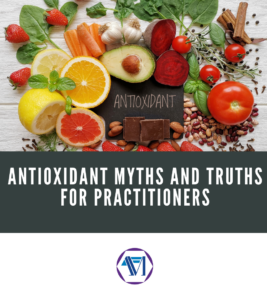 Although you may already be a savvy practitioner, I am certain you will learn something new in this video about Antioxidant Myths and Truths for Practitioners. You’ll walk away with pages of notes and practical pearls you can use in your practice right away.
Here are some of the things we’ll be discussing:
- Our epidemic of oxidative overload damage in the body: do you know the usual suspects? What about the surprising ones?
- The well-known and the often overlooked lab markers – surprising tools for understanding oxidative balance in the body.
- “Living in a bubble” protects you? No, it increases the risk of death! Here’s why.
- Too much of a good thing? One size does not fit all regarding “healthy” habits. Are you looking for the gotchas?
- Do genetics play a role? You bet! Key SNPs and familial considerations in assessing antioxidant capacity.
- Glutathione – of course! But these three less known antioxidants are major culprits in chronic disease epidemics.
- The power and necessity of hormesis: can you confidently educate, inspire, and empower your patients with this concept?
- RedOx balance: why it’s The Key to your effective intervention through the functional medicine lens.
Thank you very much for joining in the fun and learning! Please share your thoughts (please be thorough) in the “Ask a Question” area below about what inspired you in this presentation! Include what type of practitioner you are, so that we can all see your unique perspective.

P.S. If you are passionate about transforming healthcare through the power of functional medicine, we encourage you to learn more about SAFM’s practitioner training programs. Enrollment for our next cohort is now open!
To receive weekly clinical tips for practitioners – like this one – right to your inbox, register here.
Follow us on Facebook and/or on Youtube to gain more rich clinical content.
28 Questions for “Antioxidant Myths and Truths for Practitioners”
-
26
-
26.1
Yes, both are typically optimal when the reading falls in the upper third of the reference range.
-
-
25
Cari Caraway says:
The transcript link for this video is broken, I’d love to have a copy. Thank you.
-
25.1
SAFM Team says:
Thank you for the heads-up and your patience; it should be all set for your use now!
-
-
24
Gabriela Van Eperen says:
So interesting how we learn that we need to specialize in our treatment plans for each individual person and really get to the root cause of their issues rather than creating a one size fits all for our patients. So many great tips on how to get to the root cause of information. Will definitely take some other information back to clinic with me. Thank you!
-
23
Linda Marriott says:
I would like to learn more about connective tissue disorders. I recently saw a client with Marfans, a fibrillin defect. Great lecture today.
-
22
Payal Arora says:
Thank you for another pearl packed session Tracy! The piece that stood out to me as such an important reminder is that yes, it is important to boost the body’s capabilities through targeted supplementation when needed (key word: targeted), but we also must respect the body’s innate capabilities to thrive. Thus it is equally important to back off those supplements when the time is right, to allow the body’s own endogenous capabilities to take over. Use it or lose it!
Thank you! -
21
Jacqueline Watkins says:
I am a registered nurse and so thankful for all you share in these monthly videos! Today one main thing I learned is that there is a great need for balance. That oxidative stress serves a purpose and how we need it to keep things balanced. That there can be such a thing as too many antioxidants causing a deficit in keeping the body balanced. I’m also thankful for the reminder that perfectionism is not only not allows but not preferred and that some stress is helpful to keep our bodies on their toes. So freeing!

Ask a Question
Practitioner clarification questions are welcome! Please do not post personal case inquiries.
© 2017-, The School of Applied Functional Medicine | Company Values | Terms of Use | Legal/Privacy | Contact




web development by: Gordon Multimedia
What is the optimal lab reading for glutathione? Also, wondering about CoQ10? I’m thinking they should be in the upper half of the RR range?