
Search Articles
clear search termsCommon Pitfalls and Gotchas of Everyday Labwork for Practitioners
Hi!
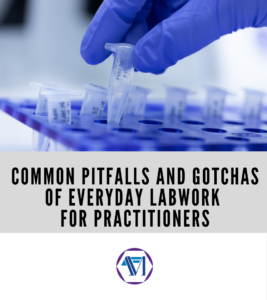 Although you may already be a savvy practitioner, I am certain you will learn something new in this video about Common Pitfalls and Gotchas of Everyday Labwork for Practitioners You’ll walk away with pages of notes and practical pearls you can use in your practice right away.
Here are some of the things we’ll be discussing:
- Why settling for WNL is not responsible healthcare. The major Gotchas within the reference ranges of annual physical labs.
- No lettuce, No Salad – how nutrient deficiencies can show up unexpectedly in everyday lab values.
- Not considering historical trends? We must! Or you may jump to the wrong conclusion.
- Still just “treating the labs”? This is not Functional Medicine at its best.
- Simple Lab Logic? You always want More of the good stuff and Less of the bad stuff. Right? Nope!
- “Sleep hygiene”, “eating hygiene”, but what about “lab hygiene”? Yes, there’s devil-in-the-detail You must teach your patients.
- The Most common missteps and mistakes that are still being frequently made in ordering and interpreting everyday labs.
- SAFM’s recommended yearly panel: What we believe Should be part of the standard annual physical labs but Isn’t!
Thank you very much for joining in the fun and learning! Please share your thoughts (please be thorough) in the “Ask a Question” area below about what inspired you in this presentation! Include what type of practitioner you are, so that we can all see your unique perspective.

P.S. If you are passionate about transforming healthcare through the power of functional medicine, we encourage you to learn more about SAFM’s practitioner training programs. Enrollment for our next cohort is now open!
To receive weekly clinical tips for practitioners – like this one – right to your inbox, register here.
Follow us on Facebook and/or on Youtube to gain more rich clinical content.
22 Questions for “Common Pitfalls and Gotchas of Everyday Labwork for Practitioners”
-
20
-
20.1
SAFM Team says:
Yes, as you will see on this page, there’s a link to a transcipt. We order custom, manual medical transcription and then proof it ourselves, so it may take several days after the live event before it’s posted. Thank you for your feedback! We are glad it’s helpful to you.
-
-
19
Wendy Nxumalo says:
Very informative, I benefited substantially thanks Tracey. It does happen a lot lot to assume that clients know what is expected of them when they are fasting for a lab. Test hence you find that they have drunk the tea or coffee or or juice.
Now what would be the treatment if ferriton is low in cases of anaemia.
Thanks -
18
Can you talk about low values. Patient has glucose 79, A1C 4.4, fasting Insulin 1.8. Thin, tired, very restrictive diet, specifically almost no grains or starch. Thanks.
-
18.1
Low values should be just as suspicious as the high ones, and you always want to be asking what may be causing it and if the value is a true ‘low.’
A good example here is the A1C marker that depends on the good level of hemoglobin and red blood cell levels. If those are low, then A1C may be falsely elevated since this market depends on the ratio of the hemoglobin to the circulating glucose in the bloodstream. Another thing to remember is that labs make mistakes – if something is oddly low, recheck it – this is particularly important in the case of fasting insulin. Then also think bigger – what other systems affect the markers you are looking at – what could this mean for the person you are working with? Also, since you are a student, you may want to know that there is an entire DDCC on “Reversing Metabolic Dysfunction” that goes into the types of dynamics that you are describing.
-
-
17
Cheryl Ledward says:
Hi Tracy, thank you so much for your insights today!! I particularly appreciated the insights about oxidative stress. Could you also speak to the relationship between ferritin and ceruloplasmin.
Thank you!
Cheryl -
16
Sree says:
Thanks for the amazing session!
I am about to graduate as a functional medicine health coach and looking forward to take SAFM some day!The most important learning is the distinction between normal levels and optimum levels. Normal is a misnomer! And, look at the person like looking at the put together total puzzle from a birds eye view instead of looking at each piece independently. They tell a different story.
-
15
Irina Stuchinsky says:
It is fascinating to me the difference between the normal and optimal range for bloodwork. Sometimes the bottom and the top numbers are so ridiculously far apart.
Thank you, Tracy!!! -
14
Using everyday lab work and looking at normal ranges is not enough! The tip about looking at optimal ranges is ‘aha’ for me. I don’t want to wait for the symptoms to head into the extremes before I take measures to help my clients.
-
13
Tamara Trinder says:
What a fabulous FB live full of practical pearls.!
The importance of being well hydrated, not rushing around and being stressed, fasting for 10-12 hours before the lab draw are such simple and practical pearls that do make a difference in the results. Evaluating the lab values based on functional medicine ranges and not just reference ranges, monitoring trends in lab values and taking the value in relation to the individual person are pearls that I find so helpful also. Thank you for an informative presentation! -
12
CJ Lewis says:
I learned so much today! I enjoy learning the interconnectedneas of the different lab markers. My gem from today was how a low bilirubin can be from missing nutrients such as B6. And a low ALP may be from low magnesium OR zinc.
-
11
Christianne Pereira Giesbrecht Chaves says:
Very good live as always! Lots of pearls. I like the importance of optimal levels, not too much of what is good neither too few of what is bad, the body needs a balance and it is totally individual. One of many pearls for today is that Ferritin is a more reliable and more conservative marker than C-reactive protein (CRP) for chronic inflammation because CRP responses quickly to improvements while with ferritin, the body just releases the sequestered iron after being sure that threat has passed.
-
10
Tracy kowalski says:
Thank you so much. I find your discussion of preparing for lab draws super important and not discussed in traditional healthcare. Also stopping supplements for a few days before. I had never heard that before and it makes total sense.
-
9
Kate says:
Another great FB live! So many pearls just regarding educating our patients in what a first morning lab draw really means! And yes, coffee counts too.
-
8
Villy says:
I really enjoyed this live, jam packed with wisdom as always. Thank you, Tracy! Take into account the whole person and not the markers in isolation is always my favourite takeaway from lab discussions. Lab draws are stressful for many and examining best practices to clients in advance is so important.
-
7
Lisa Zielbauer says:
Hi! I’m a pharmacist and my biggest takeaway was the portion on “lab hygiene.” Believe it or not, we were not taught these simple things in pharmacy school. I never knew to stop taking supplements, especially nutrients and herbs, 2-3 days before a blood draw. I actually got my blood drawn recently for lab work, and did not do this myself, so thank you for that pearl. Also, I believe the conventional medicine world teaches that fasting for blood work means you can have coffee, as long as you don’t put cream or sugar in it. This is the first time I’ve heard even black coffee is a no no, and you should only drink water beforehand. Thanks again, very insightful!
-
6
Jodi edwards says:
Thank you Tracy for another gem of a FBlive. Great reminder that what is seen in bloodwork that may be normal and sufficient for one person may be an actual functional deficiency in another. I’ve tracked all my labs for the last 20+ years and where a doctor might raise concern, it’s my normal and similarly where I pick up on trends they never do! I’ve successfully used this data to tweak lifestyle, diet and supplements throughout many life changes including menopause successfully. It truly is remarkable what you can pick up on in basic labs and to remember to not only piece the puzzle pieces together, but be aware of both lab error and as you said variables in “ lab hygiene” ( love that term) , that can influence the lab values themselves. You are a rockstar! Thanks again for all you do!
-
5
Melissa Twedt says:
I appreciate all the information about preparing a client for a blood draw. I knew about biotin and hydration.
However, thinking about being calm and not rushing on the morning of the draw should be common sense, but it is not. Also – avoiding a blood draw after any kind of trauma or excessive stress. Thank you for your inspiration! -
4
Quentin Caswell says:
So enjoyed the presentation especially understanding optimal lab levels versus “Average range”. Thank you Tracy
-
3
Joy says:
I was in the AAMP conference this weekend. One of the best talks was on breathing. Breathing through L nostril only before bed is helpful for putting one in a parasympathetic state.
So glad to hear you suggest the FULL thyroid panel. I’m so tired of just getting a TSH from other docs and having to explain to pts why we have to redraw.
One of these days, I WILL take your course. (In my spare time. LOL) You have been a wealth of pearls.
Thank you.
-
2
Heidi Hackler says:
GREAT FB Live, THANKS Tracy! I was really glad to know that “Whitecoat syndrome” can affect Fibrinogen, as mine was recently a tad high and I’ve been wracking my brain to figure out why… this may just explain the why! I recommend my clients get to their labs apt 30-min early if at all possible, then sit in the car and meditate first. Yes, I realize this may not be their true “normal”, but at least they won’t be stressed out.
-
1
Yuliyana Nikolova says:
Thank you so much for this full of pearls webinar. You did such a thorough review of the most important blood markers. My takeaway – never look at blood markers in isolation. Always look at the full picture and who that individual is.


Ask a Question
Practitioner clarification questions are welcome! Please do not post personal case inquiries.
© 2017-, The School of Applied Functional Medicine | Company Values | Terms of Use | Legal/Privacy | Contact




web development by: Gordon Multimedia
Hello,
Do you provide the transcript for all of the lives? That’s been very helpful!